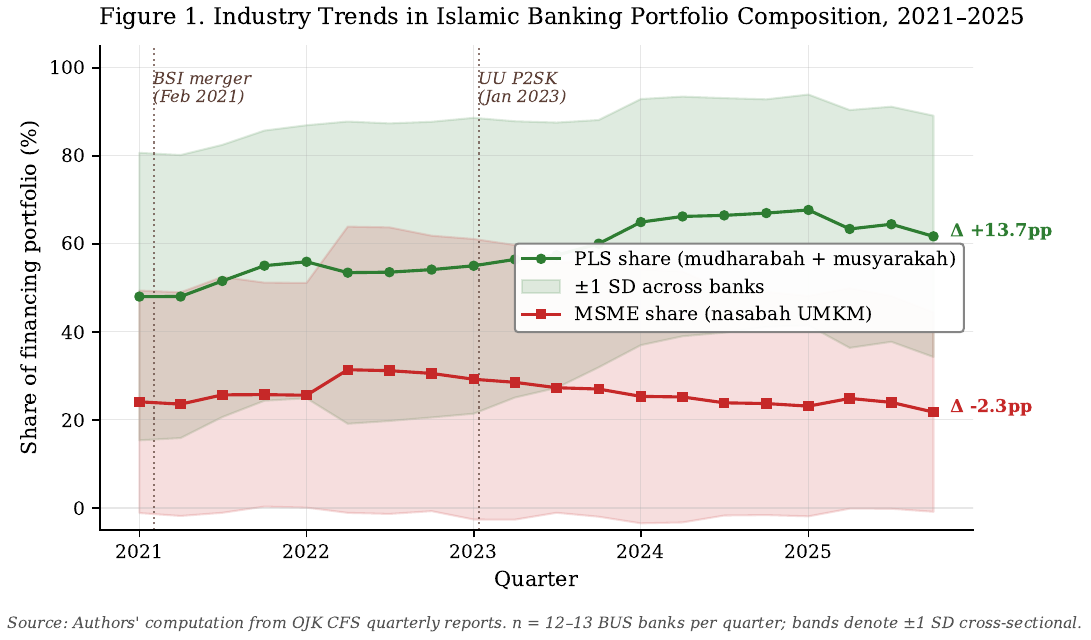
Two industry trends moving in opposite directions
Rising PLS
The authenticity signal
- Industry-mean PLS share: 48% → 62%
- Gain: +13.7 pp over 5 years
- Both mudharabah and musyarakah rising
Falling MSME
The inclusion signal
- Industry-mean MSME share: 24% → 22%
- Loss: −2.3 pp over 5 years
- Naïve bivariate: β = −0.52, p = 0.048
Scissor-like co-movement. Do these two trends reflect a structural trade-off — is Islamic banking “going upmarket”?
Three contributions
-
1First within-bank panel decomposition of PLS × MSME242 bank-quarter observations covering all 13 Indonesian Bank Umum Syariah, 2021-Q1 to 2025-Q4
-
2Theoretical extension of Stiglitz–Weiss to Islamic akad selectionIndependence of authenticity and inclusion is the predicted equilibrium, not a puzzle
-
3Digital-pivot diagnosisPost-P2SK signal traced to two digital newcomers in transition, not to a steady-state structural relationship
Data infrastructure: 609,883 line items parsed from OJK Condensed Financial Statements · open replication.
Literature: the within-Islamic akad decomposition is missing
Three strands frame the question:
A quarterly BUS panel from OJK CFS, 2021–2025
Two focal variables
- PLS share = (mudharabah + musyarakah) / total financing — from Posisi Keuangan
- MSME share = Nasabah UMKM / (Nasabah UMKM + Bukan Nasabah UMKM) — from Kualitas Aset
Bank-level controls
- Log assets, NPF gross, FDR, ROA (from Rasio Keuangan)
- Bank age · ownership class (Persero, BPD, Swasta, Joint-Venture)
- Sample straddles: BSI merger (Feb 2021), UU P2SK enactment (Jan 2023)
Ratios computed directly from bank disclosures
PLS share — the authenticity dimension
Denominator sums 6 debt-like akad (murabahah, ijarah, qardh, salam, istishna, multijasa) plus the two PLS categories.
MSME share — the inclusion dimension
MSME defined per POJK No.~11/2020 — annual revenue up to IDR~50~billion.
Panel regression with two-way fixed effects
- αi — bank fixed effects: absorb time-invariant business-model heterogeneity (ownership, region, founder identity)
- τt — quarter fixed effects: absorb aggregate shocks (COVID, BSI merger window, UU P2SK enactment)
- Xi,t — log assets, NPF, ROA, FDR (bank-level controls)
- SE clustered at the bank level (allows within-bank serial correlation)
- 4 progressively-tighter specifications: pooled OLS → bank FE → two-way FE → full controls
- Interpretation of β: within-bank, within-quarter conditional association — not a causal parameter
Industry-mean trends — the “scissor”
What the picture shows
- PLS share rises gradually — roughly monotonic
- MSME share drifts down, most drop in 2024–2025
- ±1~SD bands remain wide throughout — heterogeneity persists, not dissipates
- The industry-mean trend hides substantial bank-level variation
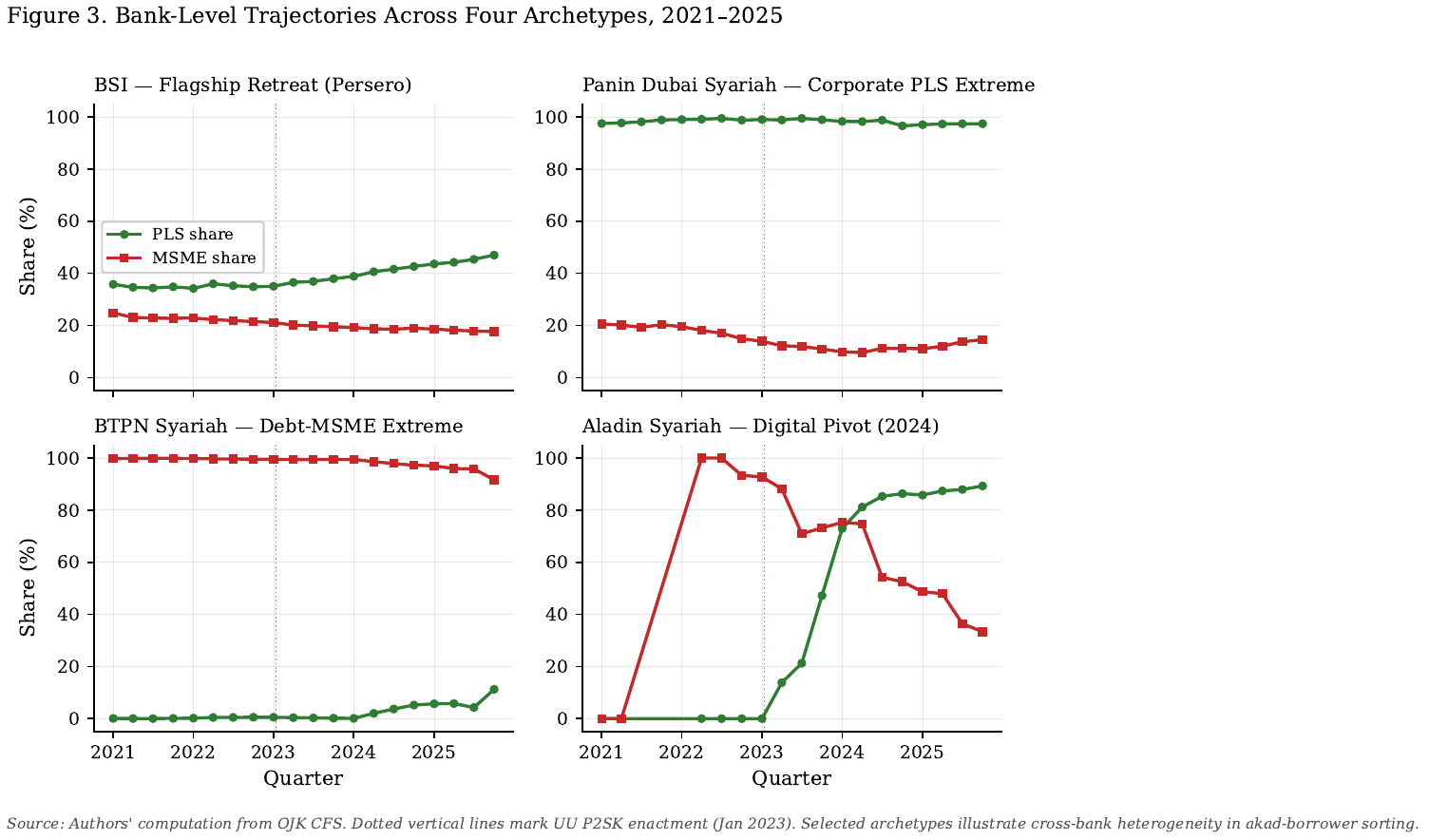
Four archetypes populate the PLS–MSME plane
The surface trade-off dissolves under panel identification
| Specification | β (PLS) | SE | p | R² |
|---|---|---|---|---|
| (1) Pooled OLS | −0.521** | 0.262 | 0.048 | 0.329 |
| (2) Bank FE | −0.133** | 0.056 | 0.018 | 0.038 |
| (3) Bank FE + Time FE | −0.111 | 0.092 | 0.227 | 0.037 |
| (4) Bank FE + Time FE + controls | +0.037 | 0.078 | 0.635 | 0.392 |
Null holds across 7 sensitivity checks — save one
| Spec | Variation | β | p |
|---|---|---|---|
| Base | Spec 4 of Table 4 | +0.035 | 0.658 |
| R1 | Drop BSI | +0.032 | 0.695 |
| R2 | Drop Panin Dubai | +0.053 | 0.577 |
| R3 | Drop BTPN | +0.048 | 0.581 |
| R4 | Pre-P2SK (≤ 2022-Q4) | −0.214 | 0.578 |
| R5 | Post-P2SK (≥ 2023-Q1) | −0.211*** | 0.001 |
| R6 | + lag PLS | +0.076 | 0.631 |
| R7 | + lag MSME | −0.078 | 0.153 |
Reading the table
- Composition checks (R1–R3): null holds
- Dynamic checks (R6–R7): null holds
- R5 post-P2SK anomaly: β = −0.211, p = 0.001
Independence is the predicted equilibrium under Stiglitz–Weiss
Two matching problems, not one
Akad selection: depends on borrower-specific monitoring cost γ. Corporate (low γ) → PLS. MSME (high γ) → debt-like.
Segmentation: depends on distribution network, regulatory mandate, target clientele.
Two decisions, two determinants — movements not mechanically linked.
Post-P2SK signal — digital-pivot diagnosis
Drop Aladin (in mid-transition): β = −0.150, p = 0.067
Drop Aladin + Nano: β = −0.147, p = 0.072
Mainstream 9 banks only: β = +0.158, p = 0.231
Post-P2SK signal is out-of-equilibrium transition, not steady state.
Five levers to lower γ and close the PLS–MSME gap
-
1Mandatory SAK EMKM adoptionSimplified accounting standards convert opaque MSME borrowers into verifiable counterparties
-
2Digital monitoring infrastructure — QRIS, e-tax, e-commerceTransactional data substitutes for traditional bookkeeping; POJK 21/2023 open-banking enables this
-
3Promote hybrid akad — musyarakah mutanaqisahDiminishing partnership reduces monitoring variance while preserving risk-sharing principle
-
4Expand KUR Syariah with PLS-eligible variantsThird-party guarantee lowers γ without banks absorbing full monitoring cost themselves
-
5MSME financial literacy programmesBorrower-side γ reduction: train record-keeping + revenue documentation
Honest limitations frame the follow-up agenda
Limitations
- Associational, not causal — both variables are jointly determined by bank strategy
- No jenis penggunaan breakdown in CFS public dataset (working-capital vs investment vs consumption)
- UUS excluded — coarser MSME disclosure precludes consistent measurement
Next steps
- Aceh Qanun LKS — sub-national natural experiment for causal identification
- Firm-level bank-borrower matching for productivity/employment outcomes
- KUR Syariah interaction with bank-level akad composition
- Cross-country comparison (Malaysia, Pakistan, GCC)
strategic dimensions in Indonesian Islamic banking —
not two faces of one trade-off.
that lowers the verification cost of MSME revenue.