The complementarity premise
Since 2020, Indonesian MSME policy has quietly bundled two levers on the assumption they are complements.
- KUR (Kredit Usaha Rakyat) — subsidised bank credit for MSMEs
- OJK financial-inclusion roadmap
- Kemenkop UMKM digitalisation initiatives
- Kartu Prakerja + digital-adoption modules
All bundle digital adoption and formal financing, implying the two reinforce each other in the field.
The unanswered question
"Does the interaction of digital adoption and formal financing actually deliver more than the sum — or does one substitute for the other?"
Nobody has tested this at the firm level in Indonesian manufacturing.
Three strands, one gap
Digital adoption & MSE scale
Goldfarb & Tucker (2019); Hjort & Poulsen (2019); Viollaz (2019); Falentina et al. (2021).
Documents positive scale effects. Rarely conditions on financing access.
Access-to-finance & growth
Beck, Demirgüç-Kunt & Levine (2006); Banerjee & Duflo (2014); Tambunan (2017, 2019).
Documents positive growth effects. Rarely conditions on digital adoption.
Digital × Finance interaction
Suri & Jack (2016); Jack & Suri (2014); Tang (2019); Cornelli et al. (2023).
Studies interaction — but in African households or U.S. small business, not Indonesian manufacturing MSEs.
The Indonesian gap: no published firm-level test of the digital-times-financing interaction across the full manufacturing MSE population. Our paper closes that gap.
Three contributions
-
1Data contributionFirm-level analysis on the near-universe of Indonesian manufacturing IMK — 94,779 firms across 23 two-digit KBLI categories from BPS VIMK 2022 Semester 2 dissemination microdata.
-
2Method contributionFive-channel decomposition of digital adoption (promotion, sales, purchasing, fintech P2P, information search), plus KBLI × KLAS sector-size fixed effects with cluster-robust standard errors.
-
3Identification contributionBaseline OLS replicated under propensity-score matching, inverse probability weighting, and a doubly-robust estimator — three causal-style estimators converging on the same coefficient bounds observable selection.
BPS VIMK22-S2 firm-level microdata
Two data constraints shape identification:
- BPS suppresses province and lower geographic codes in the dissemination file (confidentiality) — no spatial FE below the sector-size cell.
- VIMK is cross-sectional; retrospective items give only limited within-firm temporal variation.
Source: BPS Survei Industri Mikro dan Kecil 2022 Semester 2 dissemination microdata.
Baseline specification (Eq. 1)
log(Yi) = β·di + γ·fi + δ·(di × fi) + Xi'θ + αk(i),s(i) + εi
- Yi — outcome: revenue, cost, profit, employment, or revenue per worker
- di — digital-adoption indicator (composite or per-channel)
- fi — formal-financing indicator (any_formal_loan, kur_user, or bank_user)
- δ — the coefficient of primary interest: the digital × formal interaction
Fixed effects and SE structure
- αk(i),s(i) — KBLI × KLAS sector-size cell FE (46 cells)
- Xi — 11 firm-level controls (entrepreneur, firm, investment)
- SE — cluster-robust at KBLI × KLAS; wild-cluster bootstrap for selected specs
Three selection-robustness estimators
PSM
Nearest-neighbour with caliper 0.05, one-to-one matching on 12 controls + KBLI × KLAS dummies.
Balance target: |SMD| < 0.10 on all covariates.
IPW
Inverse probability weighting using logistic propensity score, truncated at 1% tails to bound extreme weights.
Common support: [0.02, 0.99].
Doubly Robust
Regression adjustment on the IPW-weighted sample — consistent if either the outcome model or the propensity model is correct.
AUC of propensity model: 0.733.
Balance diagnostic: 99.97% of firms within common support; all 12 covariates achieve |SMD| < 0.10 after matching.
The digital and financing landscape
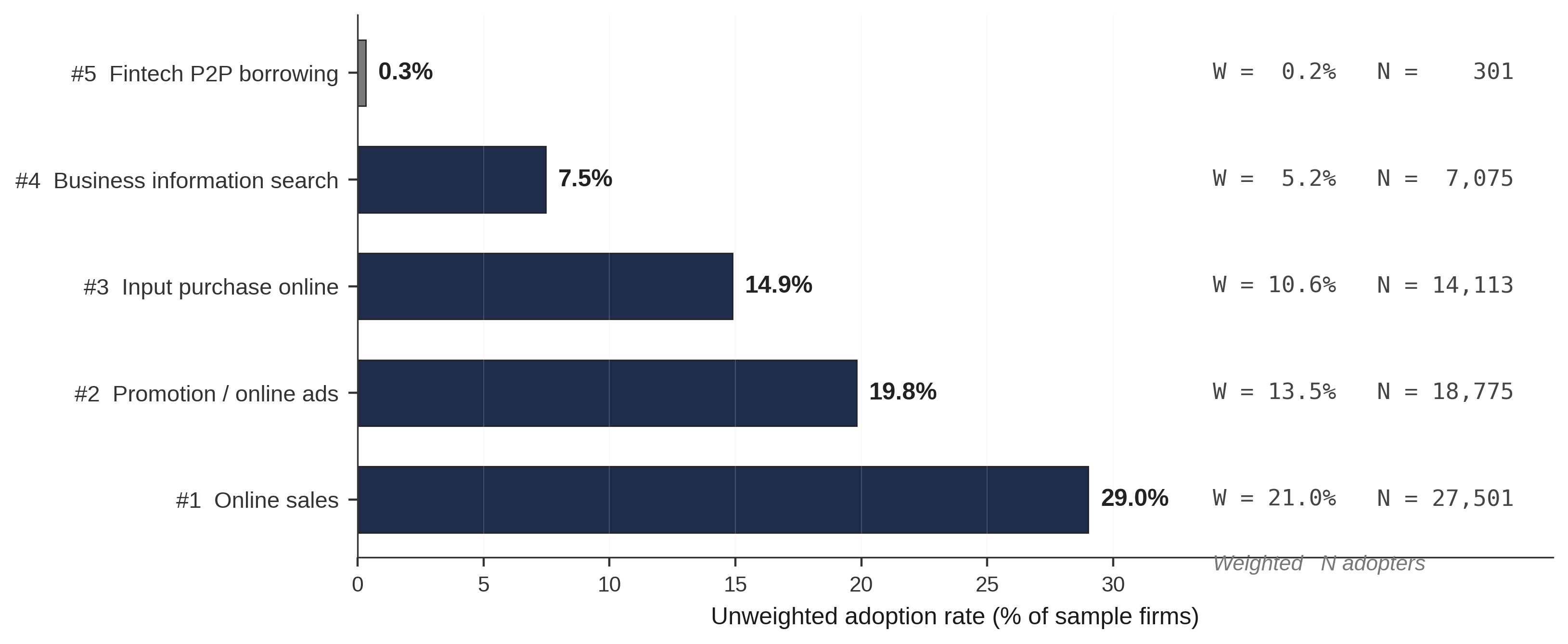
| Indicator | Share |
|---|---|
| Any digital adoption | 38% |
| Online sales | 29% |
| Online purchase | 20% |
| Fintech P2P borrowing | 0.3% |
| KUR user | 4.9% |
| Non-KUR bank loan | 3.5% |
| Self-financed | 87% |
WhatsApp and marketplace dominate the sales-platform mix. Fintech remains marginal.
Baseline OLS on log(Revenue)
| Variable | M1 | M2 | M3 | M4 (main) |
|---|---|---|---|---|
| digital_any | +0.691 | +0.657 | +0.690 | +0.483 |
| any_formal_loan | — | +0.634 | +0.795 | +0.537 |
| digital × formal | — | — | −0.316 | −0.258 |
| Firm controls (11) | — | — | — | ✓ |
| KBLI × KLAS FE (46) | ✓ | ✓ | ✓ | ✓ |
| R² | 0.201 | 0.280 | 0.328 | 0.457 |
All coefficients in M4 significant at p < 0.001. Cluster-robust SE at KBLI × KLAS (46 clusters).
27 specifications, 27 concur
| Robustness variant | δ | p-value |
|---|---|---|
| Main (M4 baseline) | −0.258 | <0.001 |
| Mikro subsample (88,918) | −0.230 | <0.001 |
| Kecil subsample (5,627) | −0.267 | 0.018 |
| Sample-weighted (pop. 4.34M) | −0.244 | 0.002 |
| Leave-one-KBLI-out (5 sectors) | −0.223 to −0.307 | all sig. |
| Wild cluster bootstrap | −0.258 | 0.001 |
Selection-robustness estimators
- OLS + controls: +0.483 (digital main)
- PSM matched ATT: +0.397
- IPW-ATE: +0.559
- Doubly-robust: +0.499
All four estimators lie within the same magnitude. Selection on observables is modest.
Not all digital is equal
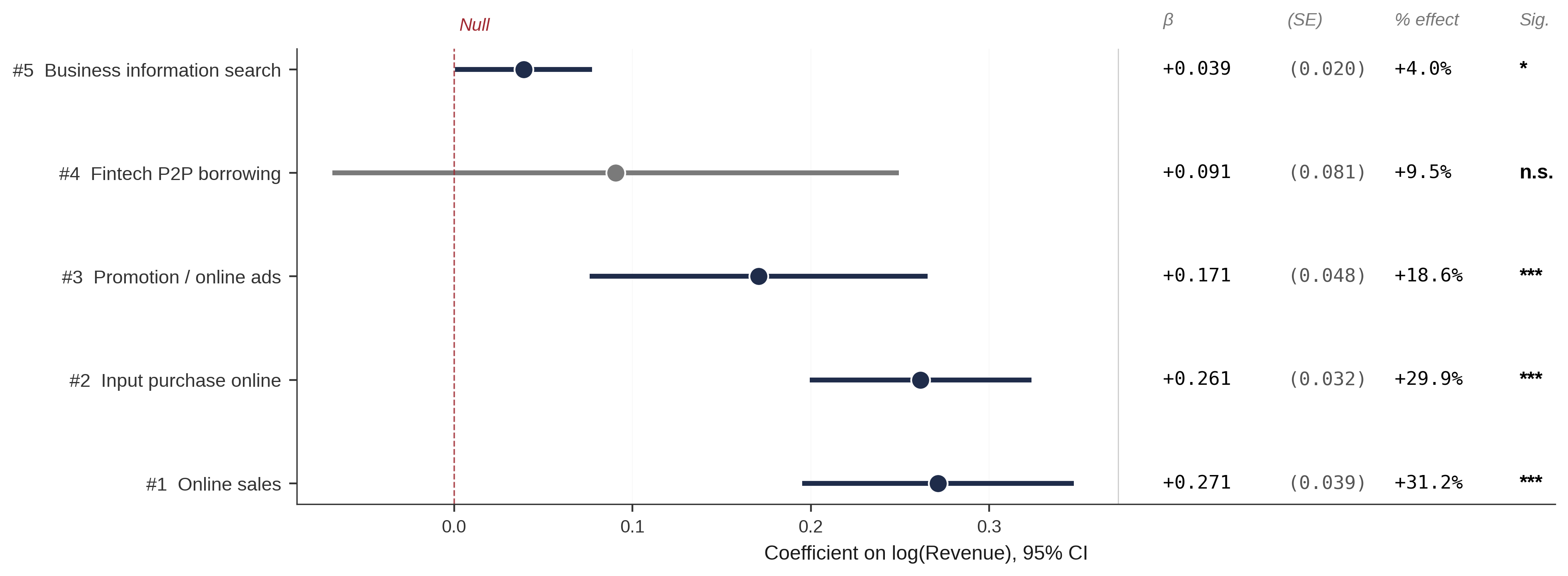
Transactional channels dominate
| Channel | On Revenue | On Employment |
|---|---|---|
| Online sales | +31% | +8% |
| Online purchase | +30% | +11% |
| Digital promotion | +9% | n.s. |
| Fintech P2P | n.s. | +9.1% |
| Info search | n.s. | n.s. |
Fintech P2P raises workers but not revenue — survival capital, not growth capital.
Three limitations we own
-
1No sub-national geographyBPS suppresses province and lower codes in the dissemination file. Sub-provincial policy inference requires follow-up with restricted-access data.
-
2Manufacturing onlyVIMK covers KBLI 10–33. Results do not generalise to trade, agriculture, mining, services, or transportation — which together form a larger share of Indonesia's MSE population.
-
3Selection on observablesWe control 11 firm characteristics and 46 sector-size cells; PSM, IPW, and doubly-robust converge on OLS. But no IV, no natural experiment. Estimates are tightly-controlled correlations, not point-identified causal effects.
Four concrete levers for OJK
-
1Abandon the universal-complementarity premiseProgramme design should stop bundling digital + financing on the assumption that stacking multiplies gains. Both are independently valuable, but the combination delivers less than the sum.
-
2Target by firm-type, not universal pushFirms with neither digital nor formal financing gain the most from any first intervention. Segmentation — not universal push — maximises the marginal Rupiah of programme spending.
-
3Reformulate fintech P2P as employment-stabilisationFintech P2P raises workers but not revenue — a survival-capital signature. Product design, disclosure, and consumer-protection frameworks should acknowledge this rather than market it as a growth tool.
-
4Invest in transactional-digital channelsOnline sales and online input purchase carry the bulk of the digital scale premium. Promotion and info search are smaller levers — programme budget should reflect the per-channel effect asymmetry.
One finding, actionable at the programme level
94,779 firms. One specification. 27 robustness variants. Three selection-robustness estimators.
All converge on one finding: digital adoption and formal financing are partial substitutes, not complements. The joint intervention delivers less than the sum. Programme design has been assuming otherwise — and the marginal Rupiah of MSME spending can be redirected accordingly.
Thanks
Badan Pusat Statistik for the VIMK dissemination programme; KARISMA OJK organising committee; HAMPARAN Institute colleagues for the analytical infrastructure.
Correspondence
Ahmad Fatikhul Khasan
HAMPARAN Institute, Jember, Indonesia
[email protected]
ORCID 0000-0003-0209-834X
Replication package: HAMPARAN research repository.